
The best exterior paint colors for most Austin homes are warm whites such as Sherwin-Williams Alabaster, soft greiges such as Accessible Beige or Agreeable Gray, muted greens such as Evergreen Fog, and dark accents such as Iron Ore or Hale Navy on doors and trim. The right exterior paint color depends on the undertone of your roof, brick, or limestone.
Below, each color is paired with a common Austin roof or masonry type, followed by how to test samples, how house style shapes the scheme, and where heat changes things for darker colors. The guide comes from Brush & Color Painting, a painting company in Austin serving Cedar Park, Leander, and Round Rock since 2017.
Best Exterior Paint Colors to Sample, by Roof and Masonry
Roof shingles, brick, stone, and window frames outlast several repaints, so they set the color palette before you open a fan deck. The table pairs widely sold Sherwin-Williams and Benjamin Moore colors with the fixed materials found on most Austin homes. Treat each row as a shortlist to sample, not a final answer.
| Roof or masonry you are keeping | Body or siding | Trim | Front door |
| Black or charcoal shingle roof | Repose Gray SW 7015 or Agreeable Gray SW 7029 | Pure White SW 7005 | Hale Navy HC-154 (Benjamin Moore) |
| Brown or tan shingle roof | Accessible Beige SW 7036 | Alabaster SW 7008 | Urbane Bronze SW 7048 |
| Terra cotta tile roof | Alabaster SW 7008 | Urbane Bronze SW 7048 | Kendall Charcoal HC-166 (Benjamin Moore) |
| Orange red brick | Revere Pewter HC-172 (Benjamin Moore) on siding and gables | White Dove OC-17 (Benjamin Moore) | Tricorn Black SW 6258 |
| Pale Hill Country limestone | White Dove OC-17 (Benjamin Moore) | Iron Ore SW 7069 | Cavern Clay SW 7701 |
| Natural cedar, stained wood, or a heavily treed lot | Evergreen Fog SW 9130 | Alabaster SW 7008 | Iron Ore SW 7069 |
Each of these color combinations follows undertone. Black and charcoal roofs suit cool and neutral body colors, while brown, tan, and terra cotta roofs suit warm ones. Orange-red brick needs a greige with a green or gray base, because a pink base pushes the brick redder. Check the light reflectance value (LRV) on the maker’s color page too, since a higher number reflects more light and heat, so lighter colors run cooler on a sunny wall.

How to Test Exterior Paint Samples on Your Own Walls
A chip viewed indoors looks nothing like the same color in natural light outside. Direct Central Texas sun pushes colors lighter and warmer, so grays with a cool hue drift toward blue and soft whites can glare on a south-facing wall. A north wall holds truer to the chip, while the west wall takes hard afternoon sun that washes out subtle colors.
- Deep porches and long overhangs add a third condition, since the shaded band under them reads several shades darker than the sunlit wall above. Put samples on the house and check all three conditions before you order paint.
- Paint patches at least two feet square. Small swatches read differently from a full wall of the same color.\
- Test on a sunny side and a shaded side. You see both ends of how the color behaves on your house.
- Check the patches at 9 am and again around 5 pm. Late afternoon is when Austin exteriors shift the most.
- Place patches beside the brick, stone, and trim. A white primer background hides undertone clashes.
- Live with the samples for several days. A color you still like after a few days is a safer pick than one chosen in an afternoon.
Call (737) 777-9026 to talk through your shortlist with our team before you order paint.
Body, Trim and Door Colors by House Style
A three-part exterior color scheme suits most homes, with a body color, a trim color, and one accent for the front door or shutters. Modern and minimal homes often work with two, and going past four usually looks busy unless the architectural details give each color a clear place.
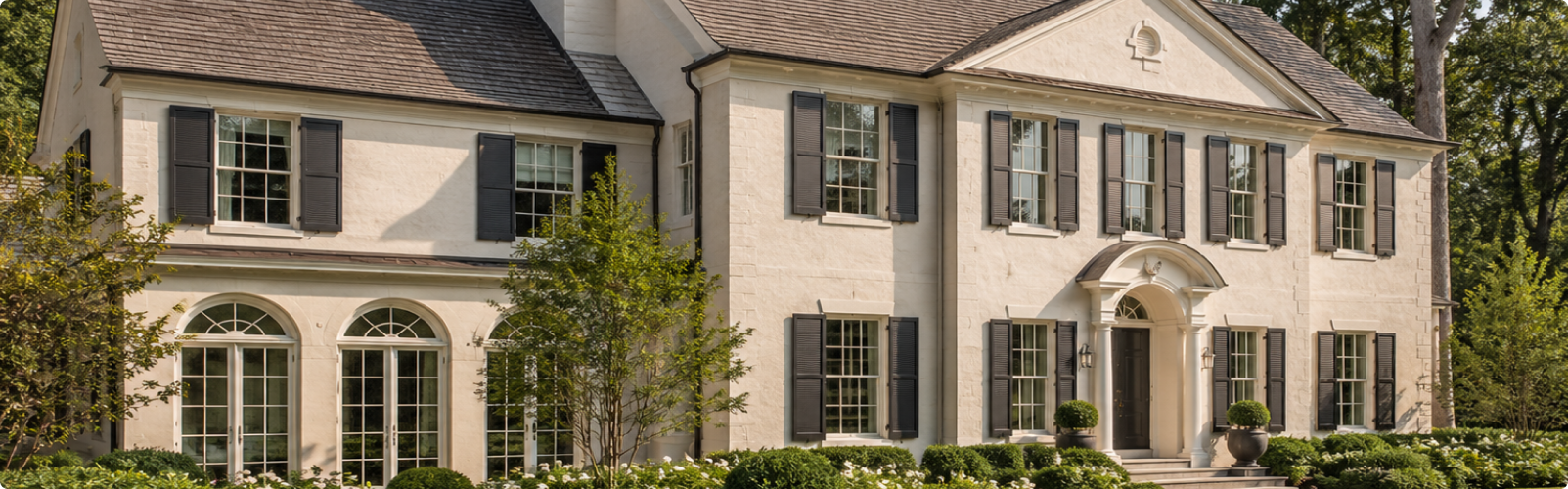
Architectural styles across Austin pull the palette in different directions. A Hill Country ranch with limestone suits earthy tones and creamy whites, a Craftsman bungalow carries deeper body colors with contrasting trim, and a modern farmhouse leans on white or light neutral tones with darker accents in black or bronze.
The front door is the safest place for a bold color because it covers little area and costs little to repaint. A navy, deep green, or terra cotta front door color on a light body adds depth and curb appeal without committing the whole house to a dark shade. Paint the garage door the same color as the body so it recedes, or match it to the trim when the panels are worth showing off.
Shutter color usually works best a few shades darker than the body or matched to the door. On a deep shaded porch, a pale porch ceiling bounces light back down and keeps the entry from feeling dark.
Check HOA Rules and the Rest of the Street
Many Austin area neighborhoods require HOA approval for exterior colors, so ask for the approved exterior palette before you settle on a color outside it. The review can also push back your start date, which matters because of when to schedule an exterior repaint here. Outside an HOA, look at the houses on either side so your color fits the street without copying a neighbor.
How Heat and Fade Affect Darker Exterior Colors
Darker colors absorb more heat. Siding and trim under a dark coat run hotter through an Austin summer and expand and contract more each day, which strains any exterior coating. Many vinyl siding makers also limit how dark you can go unless the paint is a vinyl-safe formula, since trapped heat can warp the panels.
Deep saturated colors also show fade sooner because they carry more pigment to lose. Charcoal on a west wall faces far more stress than the same color on a sheltered north side, and a black front door facing west gets hot to the touch on a summer afternoon. A dark exterior can still work here, but product grade and sheen matter more as the color gets darker, for the reasons covered in how Austin weather affects exterior paint.
Exterior Paint Color Questions From Austin Homeowners
Four quick answers on the last details of exterior house colors.
Which exterior paint colors hide dirt and dust best?
Mid-tone colors such as greige, taupe, and muted green hide dust and pollen best. Bright white shows every streak of dirt near the ground, and very dark colors show dust and water spots. A mid-tone body with lighter trim keeps a house looking clean longer between washes.
Which white paint colors work best on Austin exteriors?
Alabaster SW 7008 and White Dove OC-17 carry a soft warm base that sits well beside limestone and tan or brown roofs. Pure White SW 7005 is more neutral and reads crisper as trim against a black or charcoal roof. Hold any white sample next to your trim, roof and natural landscape before you commit, since white picks up color from everything around it.
Can you change the color of a brick house without painting it?
Yes. Limewash and mineral paint soak into brick instead of forming a plastic film on top, so the masonry can still breathe. We are a Romabio Preferred PRO and apply Romabio limewash and Masonry Flat mineral paint on Austin brick. Our exterior warranty covers Masonry Flat but not limewash, which is meant to weather and soften over time.
Does exterior paint look different on stucco, siding, and brick?
Yes. Rough stucco and brick scatter light, so the same color usually reads a little darker and softer on them than on smooth siding or trim. A home with mixed materials needs samples on each surface, since one color can look like two shades across the front of the house.
Our exterior painting carries a 5-year warranty covering peeling, blistering, and premature fading caused by workmanship. It does not cover normal UV aging or hail and storm damage.
Call Brush & Color Painting at (737) 777-9026 to talk through colors for your Austin area home before any paint is ordered.